
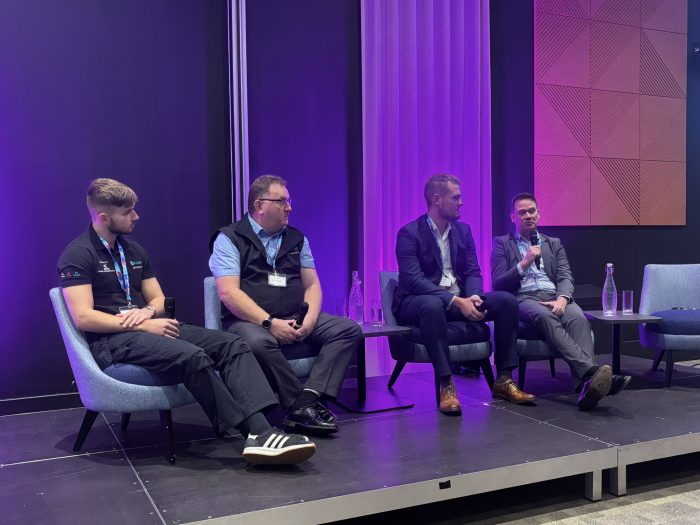
Speakers at the Derby Property Summit (Left to right) Vaillant apprentice Jack Battaram, Adam Collishaw, Vaillant’s UK learning and development specialist, Former Derby College Group T Level student Matthew Kirk (who is currently doing a degree apprenticeship with Greenhatch Group) and Sam Lewis, director of Greenhatch Group.
The event, organised by Marketing Derby and themed ‘Shaping the Future’, drew more than 200 business leaders, decision makers and investors to hear how the city’s development pipeline and regeneration plans are progressing, hosted by broadcaster Declan Curry.
People behind every ambition
While much of the summit’s focus fell on housing growth, infrastructure, regeneration, commercial development, the net zero transition and modern construction methods, DCG used its platform to make the case that none of these ambitions can be delivered without one thing: people.
Carol Dixon, director of employer partnerships at DCG, and Brian Malyan, the DCG’s vice principal for technical and vocational education, addressed delegates directly on this point, setting out the scale of the workforce challenge facing the region: an ageing workforce, ongoing skills shortages, growing demand, the rise of new technologies, the push toward decarbonisation and retrofit, and an expanding project pipeline all combining to put pressure on the sector’s capacity to deliver.
Carol said:
“When we talk about the future of the East Midlands and Derby, we talk about development, regeneration projects, infrastructure, investment and housing growth.
“But behind every one of those ambitions is a much simpler question. Who is going to build them? Because no matter how strong the investment pipeline is, nothing gets built without people.
“All of them depend on having a skilled workforce. Workforce capacity is one of the biggest constraints to growth.”

Carol Dixon, director of employer partnerships at DCG, and Brian Malyan, DCG’s vice principal for technical and vocational education speaking at the Derby Property Summit
She continued: “The challenge isn’t simply creating jobs; it’s ensuring there are enough skilled people available to deliver those opportunities, and that’s where the CTEC comes in.
“The construction sector is facing a perfect storm. We have an ageing workforce. We have persistent vacancies across multiple trades.
“We have an increasing demand for technical skills. At the same time, we’re asking the industry to become greener, more digital and more productive.
“We’re building differently to how we did ten years ago, and we’re asking the workforce to evolve with us.
“The reality is we cannot simply achieve our housing, regeneration and infrastructure ambitions unless we address the workforce challenges head on.
“The skills agenda is not just an education issue; it’s a growth issue.”
A national initiative, a regional solution
DCG’s contribution to the summit centred on its role leading the East Midlands Construction Technical Excellence College (CTEC), one of only nine such colleges recognised nationally by the Department for Education just over a year ago.
Rather than a single college acting alone, the CTEC model is built around bringing together employers, colleges, strategic authorities, industry bodies and construction sector partners under one regional structure, with DCG coordinating training specialisms, sharing best practice and working with partner colleges across the East Midlands, including Burton and South Derbyshire College, Chesterfield College Group, Leicester College, Lincoln College, North Notts College, Northampton College, Nottingham College, Stephenson College and Vision West Nottinghamshire College.
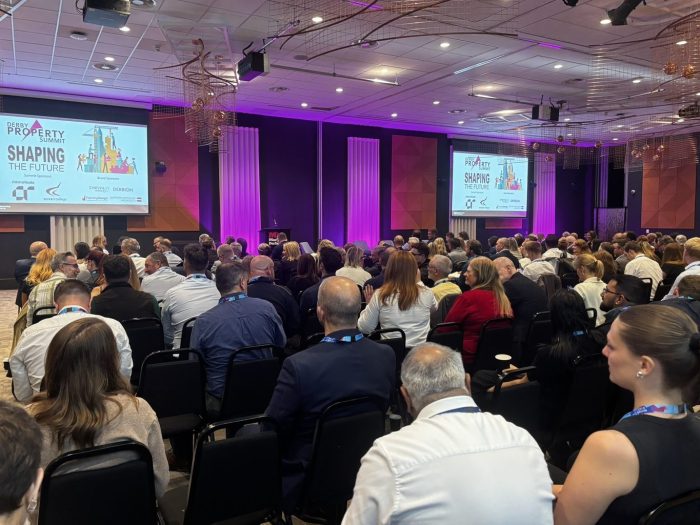
A packed room for the Derby Property Summit
The college has framed its work around five strategic objectives: delivering the precise technical skills employers need on site, ensuring consistently high-quality construction education across the region, driving active employer investment through co-investment, equipment donations and curriculum input, uniting colleges and training providers into a single coordinated network, and building clear, visible progression routes from entry level training through to high value employment.
Brian Malyan told the summit:
“What makes a CTEC different is that it isn’t simply a college programme, it’s a partnership.
“Together we’re creating a regional approach to workforce development. A regional solution to a regional challenge.”
Underpinning this work is the Teacher Industry Exchange, a scheme designed to keep classroom teaching aligned with real world industry practice by placing FE lecturers directly into commercial construction environments, while bringing experienced site practitioners into college workshops.
The rationale is straightforward: construction is evolving too quickly for education and industry to operate in isolation from one another.
Partnerships already delivering results
The summit heard directly from employers and students already benefiting from this approach.
The Teacher Industry Exchange was pioneered by Sam Lewis, director of geospatial survey firm Greenhatch Group, who said: “Without collaboration I don’t know how we move forward. Everyone wins if employers engage with education providers to help get individuals into fee earning work.”
Former DCG T Level student Matthew Kirk, now on a degree apprenticeship with Greenhatch Group, said: “T Levels are the future moving forward. They partner you with companies like Greenhatch, which introduced me to the industry and the workforce, while at college.”
Heating technology manufacturer Vaillant Group, which opened a £40 million production facility at Indurent Park Derby in 2024, has built a blended apprenticeship training programme with DCG to help address skills shortages tied to the decarbonisation of the heating sector.
Adam Collishaw, Vaillant’s UK learning and development specialist, said: “There is a shortage of skilled engineers, which is why we started the partnership with the college. We need 18,000 people in that industry by 2030. That is not far away.”
Vaillant apprentice Jack Battaram, who splits his time between DCG and hands on work at Vaillant, said: “We learn about the new technologies and systems and I’m really enjoying it.
“I take a lot away from what I learn at college and from work. I do feel that I have my future sorted.”
What success looks like
For DCG, the measure of the CTEC’s success is defined in practical terms: more apprentices, more skilled workers entering the industry, deeper employer engagement, stronger local supply chains, improved productivity, and, ultimately, economic growth across the East Midlands.
Closing her address, Carol Dixon issued a direct call to action to the room:
“My call to action to people in this room is very simple. Get involved.
“Help us shape the curriculum, share intelligence, support learners, open doors, because together we can ensure the East Midlands not only has ambitious growth plans but also the people needed to deliver them.”